
18+ 


MEK’s Hidden Headquarters: Money Laundering, Lobbying, and False Images
14.08.2025
The People’s Mujahedin Organization of Iran (MEK), known in Iran as the Monafeqin (Hypocrites), has been recognized since the 1980s as a group with a paramilitary structure and a record of terrorist activities. In recent years, however, various pieces of evidence and documentation have exposed the group’s covert financial and media activities. A RAND report reveals that the MEK, by setting up fake charitable organizations and staging aid efforts for “orphans and refugees,” raised hundreds of millions of dollars, which it then transferred to other countries through complex banking networks.[1][2]
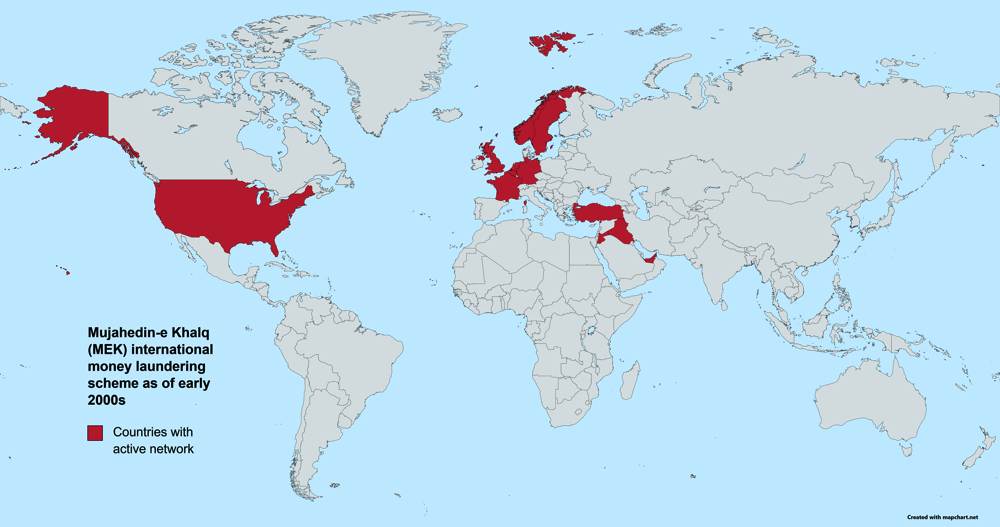
In 2001, police in the United States, the UK, and Germany uncovered traces of a large-scale money laundering operation linked to the MEK and arrested several of the group’s supporters.[3] FBI records show that in those same years, MEK leaders received hundreds of thousands of dollars through international bank accounts; for example, in 2003 French authorities arrested the group’s leaders while they were transporting $9 million in cash from Camp Ashraf in Iraq to France. They also found evidence showing that MEK members held multiple bank accounts in Europe and the UAE, containing tens of millions of dollars, and had invested in real estate and stock markets.[4]
In short, reports indicate that a large portion of the ostensibly humanitarian donations to the MEK have, in practice, gone into the group’s own coffers and have been laundered through sophisticated methods.[1][5]
This underground financial network has operated covertly in Europe and the U.S. for decades. Analysts at Responsible Statecraft, after reviewing European Parliament records and media reports, concluded that the MEK pays “huge sums” to win the backing of Western politicians and boost its credibility.[6] For example, The Washington Post reported that in recent years, the MEK has paid tens of thousands of dollars to American and European politicians to speak at its conferences and rallies—some contracts reportedly reaching hundreds of thousands of dollars.[7][6]
According to The Guardian, some of the most prominent figures from both U.S. political parties—from Rudy Giuliani and Senator John McCain to John Bolton and Francis Townsend—have delivered speeches in support of the MEK in exchange for large fees.[8][7] In the UK, MPs such as David Amess and Theresa Villiers, both known for supporting the MEK in the past, have attended MEK-organized gatherings in Paris and London. Experts say such lobbying and media campaigns are part of a deliberate effort to “whitewash” the MEK’s image and secure its removal from terrorist lists.[9][8] Overall, the evidence shows that much of the group’s foreign funding has gone not toward fighting the Islamic Republic, but toward courting Western politicians and projecting a “democratic” image.
The War of Narratives and the Whitewashing of a Terrorist Image
Alongside its covert financial activities, the MEK has sought to redefine its image in Western public opinion. As The Guardian has reported, after the U.S. invasion of Iraq, the MEK transformed its camps into propaganda exhibitions: “The Islamic Republic is repression and the MEK are the heroes of freedom” became their new slogan.[9]
To this end, the group has repeatedly denied its past terrorist identity and sought to cloak itself in the “buzzwords” of democracy and human rights, portraying a softer public image. Western media have reported that large sums of money were paid to retired politicians and media personalities to deliberately promote the MEK; for example, well-known networks like CNN and MSNBC have allowed their columnists to publish pieces attacking Iran and praising the MEK—without disclosing these financial interests.[10]
The MEK’s revival in the West has pleased hardline anti-Iranian circles. A Guardian correspondent wrote that at the previous “Free Iran” summit in Paris, dozens of prominent American and British former politicians openly called for the overthrow of the Islamic Republic and its replacement with Maryam Rajavi’s leadership.[11] These gatherings were filled with anti-Iran banners and slogans; John Bolton even in a foolish statement declared in one speech that the MEK would rule Iran and they eat ice cream in Tehran by 2019.[11]
Furthermore, The New York Times and security sources have reported that in the assassination cases of Iranian nuclear scientists, intelligence indicated that “Mossad planned the operation and MEK agents carried it out.”[12] In other words, the MEK, aligning itself with certain hardline factions in the U.S. and Israel, has used developments inside Iran to craft a “regime change” narrative in the West and to bolster its standing in foreign policy debates. While the group’s spokespeople dismiss such accusations as “Islamic Republic propaganda,” the reality is that the MEK’s new PR profile in the West rests on these hidden partnerships.[13][14]
Political Influence and International Lobbying
The involvement of high-profile Western former politicians in promoting the MEK demonstrates the group used these figures to penetrate into decision-making circles. As noted earlier, figures such as Giuliani and Bolton have advanced the group’s positions in the media for hefty fees.[8][7]
In Europe, too, networks connected to the MEK operate actively. For example, the cross-party “Friends of a Free Iran” (FoFI) parliamentary group, whose members span the political spectrum, has jointly lobbied in Central Europe to support the National Council of Resistance of Iran and the MEK.[15] Javier Zarzalejos, a Member of the European Parliament from Spain’s conservative People’s Party (EPP) and chair of the Parliament’s LIBE Committee, has also headed this parliamentary group.[15]
Despite the MEK’s terrorist record, which led the U.S. Treasury and the EU to list it as a terrorist organization until as late as 2009, the group’s extensive lobbying eventually secured its removal from such lists.[16] This was achieved primarily through massive financial expenditures and quasi-bribery of European politicians. For example, El País wrote that the MEK donated millions of euros to Spain’s far-right Vox party to push for the passage of an anti-Tehran resolution.[6]
Ultimately, the European Parliament issued a detailed report warning of “foreign interference” in European elections, implicitly referencing the MEK’s funding and lobbying role.[6] Notably, some members of these political currents have been added to Tehran’s sanctions list; for instance, in 2022 Iran sanctioned several MEPs, including Zarzalejos, for openly supporting the MEK—prompting strong protests from the European Parliament.[17]
The MEK’s Domestic and Overseas Operations
The MEK’s activities inside Iran in past decades differ starkly from its operations abroad today. In the 1980s, the group was a tightly organized militant force carrying out terrorist operations against Islamic Republic officials—bombings and assassinations in Tehran and other cities, arson attacks on train stations and government offices. Documents indicate that until its defeat in Operation Mersad (1988), the MEK carried out dozens of operations daily, accounting for over 65% of major terrorist attacks in that era.[18]
Today, however, the story is different: the MEK no longer has its past military capacity and instead appears in flashy rallies, online campaigns, and Western media. In the group’s official propaganda, traces of a “revolutionary narrative” now appear that previously had no domestic foothold. Iranian officials and some analysts say the MEK manipulates coverage of protests and unrest in Iran through social media and online channels, attempting to co-opt these events for its own benefit.
According to the Atlantic Council, domestic opposition groups—such as moderate reformists—generally prefer gradual, calculated change and fear destabilization, whereas foreign-based groups like the MEK try to steer unrest “toward sustained revolutionary and disruptive movements.”[19]
It is also reported that in recent years, the MEK has been tasked with building a clandestine network inside Iran—what it calls “Resistance Units”—and spends lavishly on propaganda in the belief it can organize public protests. Whistleblowers have told The New York Times that the MEK even pays monthly stipends to retirees and regime opponents to participate in its domestic campaigns.
At the same time, credible reports say that since the 1980s, the MEK has mainly focused abroad on “propaganda against the regime and street demonstrations” to gain leverage over Western politicians and media.[20] In other words, today their efforts center on image-building and political logistics, not on military operations aimed at overthrowing the government from within.
Role in Regime Change Projects and Hybrid Warfare Against Iran
The MEK is one of the tools backed by certain Western powers in their maximum pressure and regime change strategies against Iran. U.S. politicians have repeatedly expressed their desire for “government change” in Iran alongside the MEK’s positions. Donald Trump, in a wishful thinking, in political debates, often voiced support for domestic protests in Iran, saying Iranians “will have America’s full backing when the time comes.” something that he and his advisers—including John Bolton and Andrew C. McCarthy—have essentially forgotten is the realities of Iran’s domestic strength of patriotism, the thing that we witness in 12 day war between Israel and Iran.
A think tank close to the pro-Israel lobby (FDD) explicitly recommended in a memo to the Pentagon that groups like the MEK, along with U.S. media outlets, be used to organize and amplify social unrest.[21] Beyond this, the U.S. has openly supported UN General Assembly sanctions resolutions against Iran and has occasionally floated the MEK as an “alternative option” to cast doubt on Iran’s governance.
The MEK leadership—from Massoud to Maryam Rajavi—has portrayed itself as an ally or instrument of Israeli and Saudi anti-Iran policies; in fact, some reports allege that the group has received Saudi money and Israeli intelligence, that is why the thing we are dealing with is “State Sponsored Terrorism”.
Ultimately, the MEK’s prominent role in international media, backed by Western political and financial support, has undermined the legitimacy of Iran’s protest movements. Some observers believe it channels public anger toward the notion of “foreign interference”—a result that, rather than benefiting Iranians, intensifies “hybrid warfare” and masks Iran’s internal crises.
The evidence suggests that the MEK functions less as a grassroots force for Iran’s freedom and more as an economic and media instrument in foreign power games. Its secretive money laundering and investment networks have not only bypassed national laws in numerous countries, but have also prompted American and European political actors—driven by unclear motives—to support the group.[5][6]
At the same time, the MEK has sought to rewrite its past narratives and craft a new public image, trapping Iranians in a “foreign-flagged change” scenario—something analysts warn is directly opposed to Iran’s national interests and the spirit of domestic movements.[19]
In other words, open Western political support for this terrorist group is part of a broader anti-Iran policy campaign in which the long-term interests of the Iranian people have no place. As Daniel Benjamin, a former senior U.S. diplomat, has said, the West cannot win the trust of Iran’s domestic public without being transparent about its goals in supporting opposition groups—risking a dangerous backlash instead.[19]
Sources:
[1] [3] [4] [5] The Mujahedin-e Khalq in Iraq: A Policy Conundrum
https://www.rand.org/content/dam/rand/pubs/monographs/2009/RAND_MG871.pdf
[2] [18] [20] People's Mojahedin Organization of Iran - Wikipedia
https://en.wikipedia.org/wiki/People%27s_Mojahedin_Organization_of_Iran
[6] [15] [16] [17] MEK’s shadow in European Parliament | Responsible Statecraft
https://responsiblestatecraft.org/mek-european-parliament/
[7] [10] Five lessons from the de-listing of MEK as a terrorist group | Glenn Greenwald | The Guardian
https://www.theguardian.com/commentisfree/2012/sep/23/iran-usa
[8] [9] [11] [12] [13] [14] [22] Terrorists, cultists – or champions of Iranian democracy? The wild wild story of the MEK | MEK (People's Mujahedin of Iran) | The Guardian
https://www.theguardian.com/news/2018/nov/09/mek-iran-revolution-regime-trump-rajavi
[19] [21] What Washington’s Iran Policy Debate Misses: the Iranian People - Atlantic Council
[23] Bolton’s Ascent Gives Iranian Group a New Lease on Life – Foreign Policy
https://foreignpolicy.com/2018/04/30/bolton-iran-mek-terrorism-trump/
